
Islam is the fastest growing religion in the world, new study shows
June 10, 2025 2025-06-29 2:48Islam is the fastest growing religion in the world, new study shows

A new report from the Pew Research Center reveals significant shifts in the global religious landscape between 2010 and 2020. The study shows that Muslims are the fastest-growing religious group in the world, while the number of people identifying as religiously unaffiliated—often referred to as “nones”—is also rising sharply. Meanwhile, Christianity, although still the largest religion globally, has declined proportionally over the same period.
Released on June 9, the Pew report, titled The Global Religious Landscape, is the second major demographic analysis of its kind, following an earlier 2010 edition. Using over 2,700 data sources—including national censuses, demographic surveys, and population registers—the study examines religious affiliation, age distribution, fertility, and mortality rates across 201 countries, covering over 100,000 individuals.
According to Conrad Hackett, Pew’s senior demographer, the report aims to better understand the future of global religious populations by analyzing key demographic traits such as age, fertility, and education. “We look at the demographic characteristics of these groups because they directly affect future population sizes,” Hackett explained.
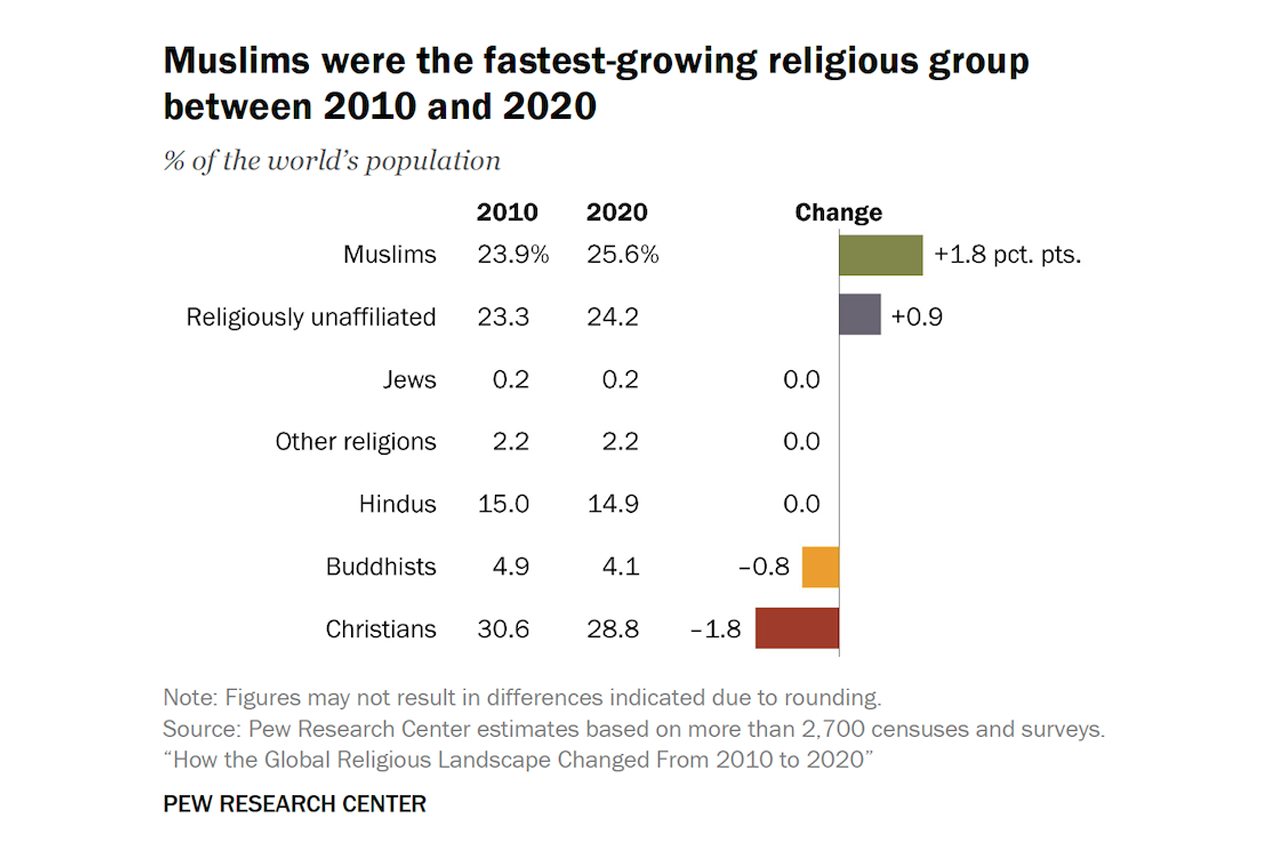
The report focuses on six major religious groups: Christians, Muslims, Hindus, Buddhists, Jews, and the religiously unaffiliated. It also includes a category labeled “others,” which encompasses followers of folk religions, Wicca, Zoroastrianism, and other smaller faiths. One of the most striking findings is that the Muslim population grew by 347 million over the past decade—more than all other religions combined. This dramatic increase is primarily attributed to natural population growth, especially in regions with high fertility rates.
“Muslims are having more children than Muslims are dying,” said Hackett. Importantly, conversion or religious switching played only a minor role in the growth of Islam. Most Muslims are born into the faith and remain within it throughout their lives.
Muslims are heavily concentrated in regions with high population growth, particularly in sub-Saharan Africa and the Middle East-North Africa, where they make up 33% and 94.2% of the population, respectively. The Asia-Pacific region, which has the world’s largest Muslim population, saw the most significant growth, with a 16.2% increase.
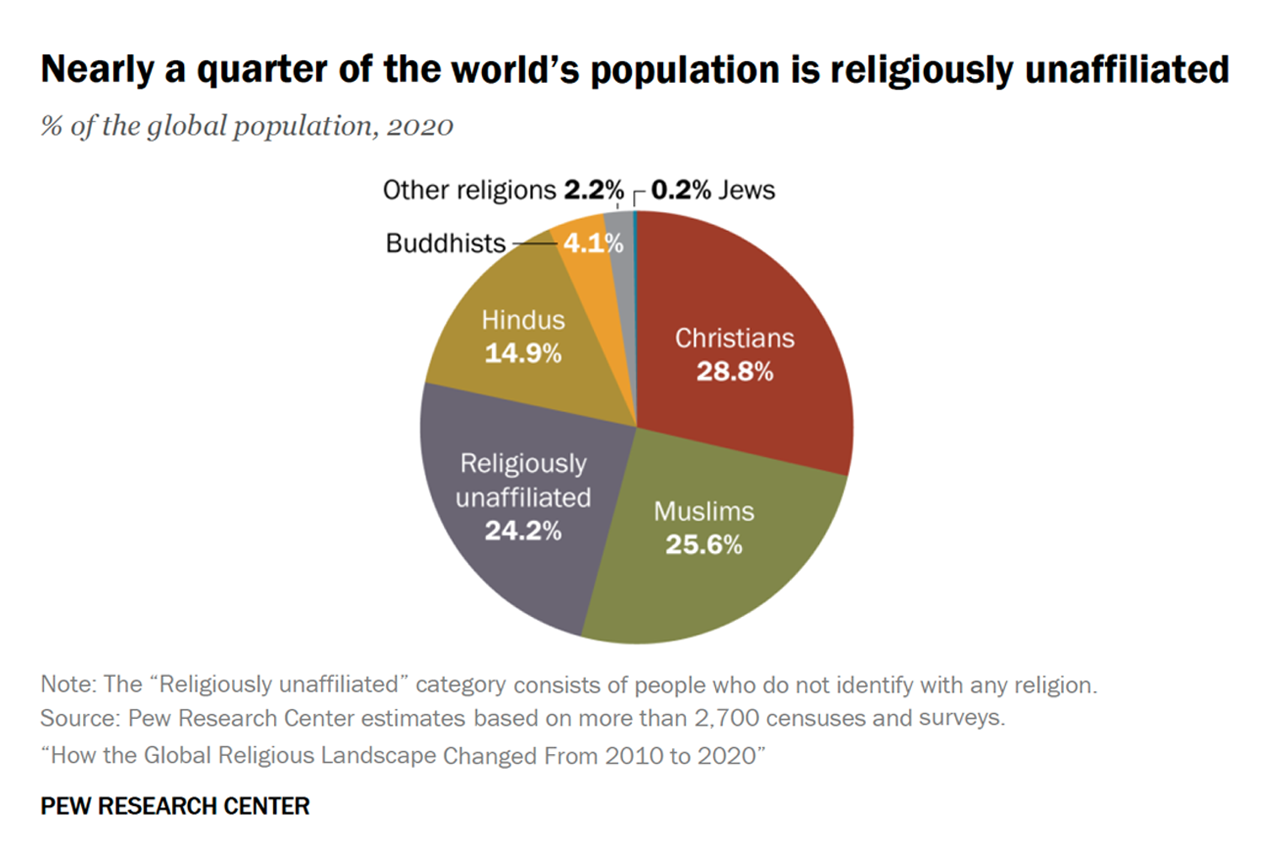
In contrast, while Christianity continues to be the world’s largest religion—accounting for 29% of the global population—its share has decreased from 31% in 2010. This decline is most evident in Europe and North America, where the Christian population shrank by 8.8% and 10.8%, respectively. In the United States, the proportion of Christians dropped from 78.3% to 64% during the decade. Several other Western nations, including France, Australia, the United Kingdom, and Uruguay, have also seen their Christian populations fall below 50%.

The decline of Christianity is due to several factors: low fertility rates, aging populations, and, most notably, increasing religious disaffiliation. In regions like Europe, Christianity now accounts for just 22.3% of the population. Conversely, sub-Saharan Africa, where fertility rates are much higher, is now home to one-third of the world’s Christians.
The number of religiously unaffiliated people—those who identify with no particular religion—has also surged. The “nones” are now the third-largest group worldwide, making up 24% of the global population. While they have lower fertility rates and an aging population, their growth is largely fueled by religious switching. The study found that for every one adult raised without religion who later adopts one, about 3.2 people leave their faith of origin, mostly Christianity.
“This trend is particularly strong in North America, Europe, Australia, and New Zealand, where people raised Christian are increasingly identifying as non-religious,” the report notes. In North America, for example, the nones grew by 13 percentage points, reaching 30.2% of the population. In Europe, they now make up 25.3% of the population. The Asia-Pacific region is home to the largest population of nones, and notably, 67% of them live in China
The Buddhist population has seen a decline of 19 million people—the only major religious group to shrink in absolute numbers. This decrease is linked to low fertility and religious disaffiliation, especially in East Asia. However, Pew notes that many who practice Buddhist rituals may not formally identify as Buddhist, complicating the measurement.
Hindus, the world’s fourth-largest religious group, represent 14.9% of the global population. The majority about 95%live in India. The Hindu population has seen strong growth in some regions, including a 62% increase in the Middle East-North Africa region, mainly due to migration. In North America, the Hindu population grew by 55%.
The Jewish population, though small in size, grew by about 6%, increasing from 14 million to 15 million between 2010 and 2020. Jews now make up 0.2% of the global population, with 45.9% living in Israel, the highest proportion in any single country. In the U.S., Jews make up about 2% of the population, a figure that includes both religious and cultural Jews
Migration is another important factor in changing religious demographics. In the Gulf countries (such as the UAE, Qatar, and Saudi Arabia), which host large numbers of foreign workers, migration has led to increases in the non-Muslim population, particularly among Christians and Hindus.
This comprehensive demographic study is part of the Pew-Templeton Global Religious Futures Project, funded by the Pew Charitable Trusts and the John Templeton Foundation. The project seeks to understand how religion is evolving and shaping global societies through rigorous demographic studies, surveys, and analyses of religious restrictions and freedoms.
Ultimately, Pew’s latest research paints a complex picture of a changing global religious landscape—one where the Muslim population is growing rapidly, Christianity faces demographic and cultural challenges, and religious disaffiliation reshapes modern secular societies.
Source: Religion News Service (RNS)